

Over the years of the Victoria Classics Book Club, our group has grown to encompass thousands of members connected by a love of reading. Below, find discussion questions for past volumes, which can be explored further on our Book Selections page. We also invite you to join the ongoing conversation on our Facebook page, where you will meet a delightful coterie of devoted readers.
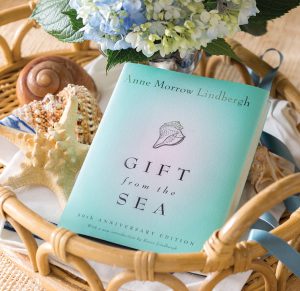 Gift from the Sea by Anne Morrow Lindbergh
In this inimitable classic, Gift from the Sea, Anne Morrow Lindbergh shares meditations on youth and age, love and marriage, peace, solitude, and contentment during a brief escape to the shore.
In the first chapter, Anne writes, “Patience, patience, patience, is what the sea teaches. Patience and faith.” What or whom has taught you patience? How?
As Anne ponders “the shape” of her life, she expresses the desire to live “in grace” as much as possible, defining grace not in a theological sense but as an inner harmony. It is a noble goal but one that is not always easy to achieve. What are some of the ways you work toward attaining her concept of grace?
When Anne wrote this book, she was in a very busy stage—a wife, a mother to five children, and running a household with all that entails. Rather than the simple life she desired, she was struggling with the “life of multiplicity.” She likened her role to that of the hub of a wheel; she was the center with all the various spokes radiating out. The dilemma was trying to find a balance between her duties and her need for time for her own interests. How have you been able to balance these two sides of your own life?
In the second chapter, Anne speaks of the “art of shedding,” which refers not only to the physical pared-down wardrobe for her beach vacation, but also to vanity, pride, hypocrisy, and other intangibles. She writes, “I shall ask into my shell only those friends with whom I can be completely honest … The most exhausting thing in life, I have discovered, is being insincere.” Do you have a friend with whom you can relax all pretenses and just be yourself?
While observing the moon shell, Anne writes, “Eternally, woman spills herself away in driblets to the thirsty, seldom being allowed the time, the quiet, the peace, to let the pitcher fill up to the brim.” With so many obligations, it’s sometimes hard to find time for ourselves. How do you refill your own vessel?
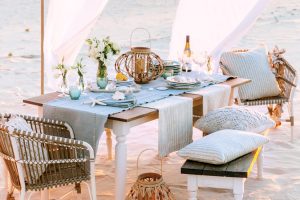
Waves lapping against the sand give a gentle cadence to a sunset dinner. As mellowing light bathes the scene in radiance, settle in for a relaxing evening of mouthwatering fare.
“Here is a strange paradox,” Anne writes. “Woman instinctively wants to give, yet resents giving herself away in small pieces.” She goes on to contrast the frustration experienced while feeling energy leak down the drain with the joy cultivated through focused service. “Purposeful giving … belongs to that natural order of giving that seems to renew itself even in the act of depletion,” she adds. “The more one gives, the more one has to give.” Have you found this to be true?
Anne was a true believer in the importance of solitude. “Every person, especially every woman, should be alone sometimes during the year, some part of each week, and each day,” she writes. Do you agree with her? How do you find solitude, and in what ways do these periods of quiet contemplation enrich your life?
Anne’s Double-Sunrise shell is composed of two perfect mirror images, joined together at a tiny spot in the middle. She likens this intact shell to the early stages of a relationship: “Two people listening to each other, two shells meeting one another, making one world between them.” Just as being battered about by the sea makes it difficult for the two sides of the shell to remain attached, so, too, “the accumulations of life and time” often place great stress on a relationship. But Anne lends a hopeful note: “In a growing relationship, the original essence is not lost but merely buried under the impedimenta of life. The core of reality is still there and needs only to be uncovered and reaffirmed.” What are some special ways you and your partner have found time to reconnect?
“If only we could have each of our children alone, not just for part of each day, but for part of each month, each year,” muses Anne, “would they not be happier, stronger and, in the end, more independent because more secure?” What are some of your most treasured memories of one-on-one time spent with your parents or with your children?
Anne suggests that middle age can be the period of shedding the shells that constrain our earlier years, from the quest for success and material possessions to the impediments of ego and pride. “Perhaps,” she writes, “one can at last in middle age, if not earlier, be completely oneself.” Looking back to your previous decade of life, how have you grown or changed? Where do you hope to be ten years from now?
In the closing pages of Gift from the Sea, Anne talks frankly about her adjustment to the empty nest. “When a mother is left, the lone hub of a wheel, with no other lives revolving about her, she faces a total re-orientation,” she writes. “It takes time to re-find the center of gravity.” Have you navigated this transition, or another significant life change? What wisdom or encouragement would you pass along to those who will follow behind you on that path?
Is there a quote that will stay with you long after you have closed Gift from the Sea? If you have read the book more than once, how has it impacted you during different stages of life?
Find Victoria Classics Book Club resources—including discussion questions, companion materials, and a reader forum—at Victorimag.com!