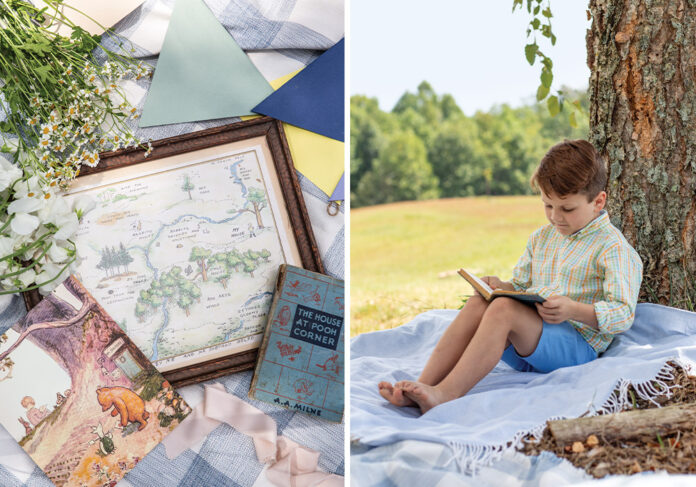
In the garden of the library, readers begin to grow. Young minds, like small saplings, stretch ever toward the sun and are swayed by each tale they encounter. The main players in those stories—whether real or fictional—become enduring companions. Victoria readers share beloved childhood characters and tell how these literary personas impact their lives for the better.
At age eight, I fell in love with Sara Crewe, the heroine of A Little Princess by Frances Hodgson Burnett. Like Sara, I embraced reading and learning and spent hours playing with my dolls. But what I liked most about Sara was how she showed kindness to everyone, from sharp Miss Minchin to Becky, the scullery maid, and to young homesick Lottie. Although the staff at Miss Minchin’s boarding school treated wealthy Sara as if she were a little princess, Sara recognized royalty’s responsibility to illustrate kindness and selflessness.
After Sara lost her wealth and her status was lowered to a maid, she reminded herself a genuine princess would still treat others with respect and kindness. No matter how Miss Minchin abused Sara, the young heroine maintained her vision. One of my favorite scenes was when Sara found a small coin, looked up, and saw a bakery. She asked the baker if anyone had lost a coin, and the woman told her to claim it. Sara bought a dozen buns, but as she left, she spied a beggar girl. Despite her own hunger, Sara gave the girl all but one bun.
Like other readers, I rejoiced when the gentleman next door discovered Sara was the child he had searched for and restored her good fortune. But adversity taught Sara not to take her comfortable life for granted, and like a true princess, she looked for ways to share her wealth with those who needed a little help.
For years, I wanted to respond like Sara when I interacted with other people. Even in high school, I reminded myself to behave like a little princess in all situations. When the college I attended awarded me a book prize that I could spend on any books other than textbooks, I knew exactly what I wanted: One Christmas, a friend’s mother gave her daughter a copy of A Little Princess illustrated by Tasha Tudor. I coveted my friend’s book and longed for my own copy. My prize paid for the handsome edition, and over the years, I have read it numerous times.
Now, when I spy signs in my doctor’s office or in our local school encouraging everyone to be kind, I think of Sara, who still shows readers how to respond to others with patience, respect, and gentleness.
Joan Donaldson
Fennville, Michigan
I had a few books as a child, but I especially recall one title: Amelia Bedelia by Peggy Parish. If I am honest, it is the only book I can remember my mother reading aloud to me, though I am sure there were others. I liked the lilt of the rhyming and repeated words. Amelia Bedelia’s name alone was fun to say! Her habits of literally interpreting written instructions often misled this maid, causing Mrs. Rogers, her employer, to bristle and scold the poor dear. Yet ever-cheerful Amelia Bedelia had an antidote to her misinterpretations: a lemon meringue pie that delighted Mr. Rogers’s taste buds and, since he was the one paying her wage, all the mix-ups would be straightened out with his first bite.
Amelia Bedelia’s charm, for me, was her perpetually sunny disposition. With her winning smile, she’d tackle any task on her “do-to” list: “Dress the chicken for dinner.” No spice rub needed; Amelia Bedelia quickly sewed a little green sailor suit and dressed the chicken! “Draw the drapes” resulted in a pen-and-ink sketch of the living room window treatments.
As a child, I mixed words up, often hearing one thing and saying another. I was prone to transposing first letters of compound words—“kea tettle” or “runny babbit.” Because of this, I felt a kinship with Amelia Bedelia and her wacky ways. Her kind attitude and ability to laugh at her mistakes were great lessons to learn at a tender age and ones I carry with me today.
And, just in case I make a truly disparaging faux pas with my words, I’ll remember that having a lemon meringue pie handy is always helpful!
Jennifer Stowe
Ethridge, Tennessee
Anne Shirley from Anne of Green Gables by L.M. Montgomery is a character with whom I’ve always identified and who has inspired me from childhood to adulthood—remaining forever a true kindred spirit!
Anne is courageous, imaginative, and a dreamer. A young girl with big feelings, ideas, and a vocabulary to match, Anne is not always understood by those around her, but this never keeps her from pursuing her interests with passion.
I have identified with all these traits, aspiring to mirror them in my own journey, especially Anne’s ability to stay true to herself, even if it means she will be different than everyone else. If Anne can be herself, then so can I!
I have Anne to thank for encouraging me as I embarked on my own adventure: a trip with my parents to Prince Edward Island, the Canadian destination that inspired the setting in which her story takes place. I was lucky enough to visit twice with my parents, which none of us would have considered doing if it weren’t for Anne and her love of the island’s beauty and community. My connection with Anne led to a special connection to this place. Though I had never visited before, everything immediately felt familiar and comfortable, from the harbor of Charlottetown to Green Gables itself.
Because of our shared love for imagination and the courage with which she has inspired me and countless others, I will always cherish the connection I have with Anne.
Katie Swaim
Albuquerque, New Mexico
One of my mother’s favorite books was Little Women. I was named Amy Jo after two of the four sisters in the book. After reading Little Women myself, I found my soulmate in Jo. She loved to read and wanted very much to become a writer. I, too, am a voracious bookworm, and Jo’s wish to become a writer had been my own aspiration for many years. In the past several years, that dream has come true: I have written and published three novels! Jo’s passions are mine. Her determination to succeed has always been my inspiration.
Amy Jo Heyman
Sheboygan, Wisconsin
My favorite book when I was in the sixth grade was The Witch of Blackbird Pond by Elizabeth George Speare. It was my first foray into historical fiction, and my love for history was ignited by the main character, Kit Tyler. Looking at life through her eyes, living in Puritan Connecticut, feeling misunderstood, and dealing with real people from history (one to whom my now-husband is related) is what allowed me to understand that humans share the same qualities, whether it is across the globe or across the timeline.
I was surprised to find that not only could I relate to Kit’s “fish out of water” experiences, but I could also imagine her relating to me. I felt she would understand my reluctant move across the country from beautiful, green Delaware to the desert of Arizona.
I still recommend this novel, even giving it as a gift to young ladies in hopes that they will both discover an appreciation of history and find where they might fit in this world. This story of acceptance is something I still remember whenever feeling out of place. Kit continues to inspire me to have confidence in myself and compassion for others.
I was ecstatic to find the house upon which the author based her story in Wethersfield, Connecticut. The Buttolph-Williams House is part of the Webb Deane Stevens Museum and can be visited from May to October.
G. G. Graeff
Phoenix, Arizona
When I was eight years old, my third-grade teacher read Charlotte’s Web aloud to us, and I was enchanted. I was quickly pulled into the plight of little Wilbur and Fern and the awful discovery that in the fall, Wilbur would be turned into bacon! Enter Charlotte, just a common grey spider—so small and seemingly insignificant, but upon her entry into the story, peace and hope are immediately reestablished.
The thing that made the very biggest impression on my eight-year-old mind was that Charlotte, without having any idea how she could possibly do it, promises Wilbur that she will save his life. Thanks to the very authority with which she assures him, Wilbur believes her and is comforted, even though she is only a little spider. I was calmed and believed her, too. I was so impressed with her bravery and gumption and trust in her own ability to solve a seemingly impossible problem.
She doesn’t say, “I have a solution, and I will help you.” She instead says, “I don’t have a solution, but I will think of one and help you.”
This was completely amazing to me, especially as I related more to the sensitive and panicked Wilbur in the way I tended to react to problems or bad news. Yet Charlotte kept her head when Wilbur and everyone in the barnyard were being swallowed up by fear.
I spent so much time wondering how a mere spider was going to save a pig from being butchered. I thought her solution was brilliant. It was almost as though she asked herself, “What do I have control over in this big wide world? Well … I have my web.” She then uses the small and humble thing that is within her grasp to make a big impression on the farmers and the town and ultimately saves Wilbur’s life.
As a child, I was having trouble making the transition to chapter books and being able to comprehend what I was reading, so after my teacher finished the book, I reread it myself. Knowing the story, I was able to follow along. I read the book five times in a row that year!
The character of Charlotte is what kept me fascinated and coming back again and again. I adored her!
Without trying to make it happen, or even realizing I was doing so, I emulated her. I even came up with something that became a slogan of mine, which I use to this day. When presented with a difficult problem, I clearly proclaim with calming confidence, “I will now think of a solution.” And then I do! At the young age of eight, I learned that if you don’t give in to panic but instead have some faith and give yourself a chance to really think about it, you can always find a solution. All these lessons, just from a little fictional spider!
Maren Latham
Parkland County, Alberta, Canada
When I was learning to read in the first grade, I discovered my love for Madeline books by
Ludwig Bemelmans.
As the title character, Madeline was fearless and not afraid to be different or speak out in her very structured world. I was aware that my grandparents were from France originally, so I was fascinated that Madeline lived in Paris with eleven other girls and the strict but caring Miss Clavel.
Madeline taught me that it was alright to be authentic and not always conform. She was not disobedient, just adventurous and brave, and I always wanted to be more like her.
The books also created for me a strong desire to visit Paris and investigate some of the scenes in which Madeline’s adventures took place. I got my wish to visit Paris many years later, and my love for all things French still holds true.
Madeline had an early influence on me that I believe remains to this day.
Wendy Tharou
Red Deer, Alberta, Canada
To read more letters from our readers about beloved childhood book characters, see “Of Great Character” in the September/October 2024 issue, available on newsstands and at victoriamag.com. Plus, submit your thoughts for our current Reader-to-Reader prompt for a chance to have your letter printed in an upcoming issue of Victoria!